Library
Book
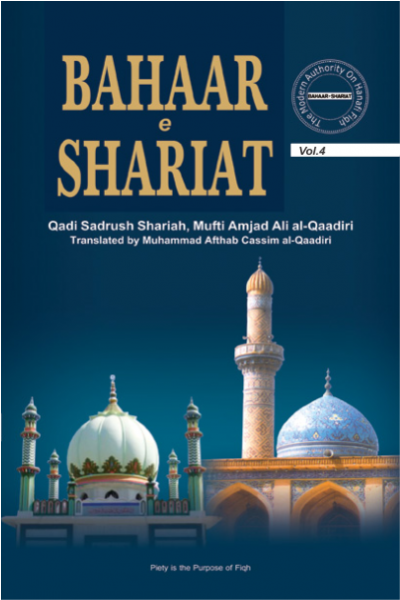
Bahaar-e-Shariat Volume 4 (Book on Salaah)
Admin · PDF · Bahaar Vol.4.pdf

This volume provides a comprehensive legal and spiritual framework for the performance of various forms of Salah, ranging from obligatory and emphasized sunnah prayers to specific communal and situational rituals. The text details the jurisprudence governing prayer in diverse circumstances, including illness, travel, fear, and congregational settings, while also outlining the rites associated with the end of life, funeral proceedings, and the status of martyrs.
Key topics & takeaways
Witr and Sunan Prayers
- Status of Witr — the work holds that Witr is waajib (compulsory), and if missed, whether intentionally or by mistake, its qaza (makeup) is also waajib (page 6).
- Performance of Witr — it teaches that Witr consists of three raka'ats with a waajib first qa'da (sitting), and it cannot be performed while sitting or on a conveyance without a valid reason (page 6).
- Dua-e-Qunoot — the text states that reciting Dua-e-Qunoot is waajib in the third raka'at of Witr, and it should be recited softly by the Imam, munfarid (individual), and muqtadi (follower) alike (page 9).
- Sunnat-e-Mu’akkadah — the volume classifies specific prayers, such as the two raka'ats before Fajr and the four before Zuhr, as Sunnat-e-Mu’akkadah, noting that habitual omission of these is sinful and may lead to the deprivation of the Prophet’s intercession (page 18).
- Performance of Sunnah — it teaches that four-raka'at Sunnah prayers, such as those for Zuhr or Jummah, must be performed with a single set of salaams at the end of the fourth raka'at rather than in two-cycle increments (page 19).
Congregational and Situational Prayer
- Jummah requirements — the work details the virtues of Jummah, including the importance of bathing and using fragrance, and warns against the prohibition of climbing over the necks of people to reach a spot (page 2).
- Prayer during illness — the text provides regulations for those unable to stand, teaching that one should perform the prayer while sitting or lying down if physical incapacity prevents standing (page 2).
- Traveler’s prayer — it outlines the rules for Namaaz-e-Musafir, which allows for the shortening of prayers for those on a journey (page 2).
- Namaaz-e-Khauf — the volume details the specific methods for performing prayer during times of fear or danger, supported by Qur'anic verses and Ahadith (page 3).
- Eclipse and Rain — it provides the legal procedures for Namaaz-e-Kusoof (solar eclipse), Namaaz-e-Khusoof (lunar eclipse), and Namaaz-e-Istisqa (prayer for rain) (page 2).
Death and Funerals
- Care of the dying — the work instructs on the proper conduct at the onset of death, including the dua to be recited when closing the eyes of the deceased (page 3).
- Funeral rites — it provides detailed laws regarding the ghusl (bathing), kafan (shrouding), and the method for performing the Janaazah (funeral) prayer (page 3).
- Burial and visitation — the text covers the etiquette of carrying the funeral bier, the burial process, and the proper manner of performing Ziyaarat-e-Quboor (visiting graves) (page 3).
- Condolence and mourning — it establishes the laws for Ta’ziyat (offering condolences) and explicitly prohibits Noha (lamenting or wailing over the dead) (page 3).
- Status of the Martyr — the volume defines the categories of a Shaheed (martyr) and explains the rewards associated with this status, as well as who else may receive similar spiritual recompense (page 3).
Read the book
Bahaar-e-Shariat Volume 4 (Book on Salaah)